Iowa Code chapter 22
Records requests
Public-records requests to the Altoona Police Department about its plate-reader program, grouped by topic: what was asked for, what came back, and how long the department took. Every record the department released is posted below as a redacted copy, so you can check each claim this site makes against the page it comes from.
What the records show sums up the batch, and Ask for records yourself explains how to file your own request under Iowa law.
By topic
What was asked for, and what came back
Loading the request tracker…
Timeline
How long the department took to respond
Each request is shown by season as one span, from the request to the department’s records or answer, rounded to the week. Quotes are the department’s own words from its replies.
People
People in these records
Officials and department staff named in these records or in the department’s replies, each linked to their profile. Each line says only what the records show them doing. No one else is named.
Records
The records, redacted
Each record has its own link you can share. Open one to see what it says, what was removed, and where this site cites it. The files are image-only copies; each summary below gives the key facts as text.
Received but not posted
What the records show
How the documented ALPR record developed
The released production includes Flock agreements, Flock invoices (summed by year under “Contracts and invoices” below), the department’s ALPR policy, a records-retention schedule, City memos, annual reports, and white papers. Most are posted above, redacted; Received but not posted lists the rest.
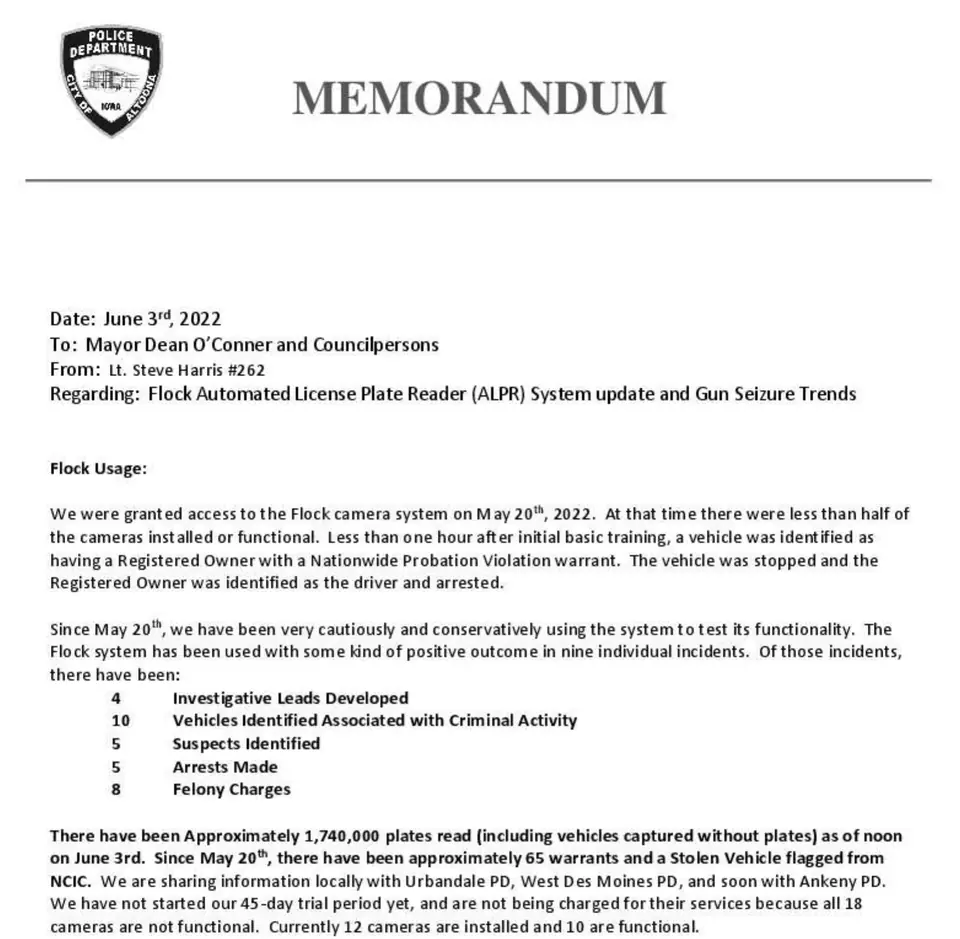
The first Flock update to the Council, June 3, 2022
 Open the full page (PDF)
Two weeks into the pilot, the department told the Council how many plates the cameras had read and how many were working. The memo’s figures are the department’s own.
Source: Police memo to the Mayor and Council, June 3, 2022, page 1, released under Iowa Code chapter 22; redacted copy (about this record).
Scope note: An invoice is not proof of payment, a policy is not proof of compliance, and a configured network relationship is not proof that another agency searched Altoona data, viewed a plate record, or exported information.
The batch documents a continuing vendor relationship.
Agreements dated from 2022 through 2024 and the listed invoices establish a documented vendor relationship. INV-43324 lists the largest total, $101,850. INV-8315 lists $27,000 for Falcon and implementation; its filename and the department’s handwritten approval stamp reference asset forfeiture and DEA, but the invoice text does not independently establish the funding source. All the invoices and the order forms are posted above, redacted.
What the released invoices bill, by year
| Invoice year | Invoices | Billed, as printed |
|---|
Source: records-requests.json, each invoice’s printed total.
Outside reporting. Another requester received a different set of procurement records, and the outlet that reviewed them reports more than these records state: 20 Axon Fleet 3 patrol-car readers (18 ordered in May 2023, a signed add-on for two more in July 2024, renewed in a 2025 agreement) and an August 2023 Motorola Solutions (Vigilant) subscription to its LEARN platform that runs through September 30, 2026. It also reports that the file it reviewed has no device inventory, which is true of this release too. This release holds no Axon or Motorola contract, so the two accounts cannot be set side by side here; the department’s reply on other plate readers is still pending (the open request). Source: Restoring Democracy’s Promise, “Altoona’s Plate Reader Network Goes Beyond Flock,” Timothy C. Tucker, September 14, 2026 (updated September 17).
Configured sharing is not search activity.
The export lists which organizations Altoona’s Flock network is configured to share with; its row counts are in this data file. The snapshot does not show who searched, the reason or case number, whether a result was viewed, or whether data was exported.
Outside reporting. The outlet describes a different list: a VehicleManager report generated by Des Moines and dated August 17, 2026, showing Altoona set to share and receive plate detections with no hotlist sharing either way. It notes, as this page does, that a setting is not a record of any data exchanged. Source: Restoring Democracy’s Promise, “Altoona’s Plate Reader Network Goes Beyond Flock,” Timothy C. Tucker, September 14, 2026 (updated September 17).
Policy 424 creates documentation expectations.
The policy says ALPR searches should include a valid case number or detailed reason, identifies additional documentation for another agency’s request, and calls for regular audits (Policy 424, pages 2 and 3).
Outside reporting. The same outlet read the same section 424.6(c) wording and reports that the audit documents it received contained no audit report or schedule. It also reports that in a September 17 update the Chief told it Policy 424 will be revised to document quarterly audits; the department’s 2025 annual report says audits are quarterly, and the policy copy released here does not. Source: Restoring Democracy’s Promise, “Altoona’s Plate Reader Network Goes Beyond Flock,” Timothy C. Tucker, September 14, 2026 (updated September 17).
Two readings of the retention schedule.
The retention schedule released here (file dated December 15, 2025) lists “Flock, LEARN, Axon” and keeps plate-reader data “up to 30 days or determined by ALPR vendor.”
Outside reporting. The outlet reports that the schedule it saw lists “Flock, LEARN” and reads “Up to 180 days or determined by ALPR vendor,” and sets that beside Iowa Code section 321P.4’s 30-day deletion rule. The outlet does not date its copy, so the two may be different versions of one schedule; neither record says which came first. Source: Restoring Democracy’s Promise, “Altoona’s Plate Reader Network Goes Beyond Flock,” Timothy C. Tucker, September 14, 2026 (updated September 17).
The 2025 annual report describes ARTIC.
The department says the Altoona Real-Time Intelligence Center combines city cameras, ALPR, drones, dash cameras, and body-worn cameras.
Keyword searches alone did not reveal the approval trail.
A keyword search of the Council’s posted agendas and minutes for “Flock,” “ALPR,” “license plate reader,” “plate reader,” and “Axon” is in this dated data file. A match is a word in a document, often in public comment, not a Council action. No match does not establish that Council never considered the program; budget documents, consent items, agenda packets, staff reports, and procurement files may use different language. Asked for approval records, the department answered that the program was approved verbally and funded through the annual budget (the department’s reply).
The City describes staged authorization.
The department’s technology page FAQ describes a 2022 pilot, subscriptions included in annual operating budgets, a 2024 Flock expansion, and a July 21, 2025 consent-agenda vote on an Axon agreement containing Outpost ALPR units. Only the last stage matches a record in our vote data: the July 21, 2025 meeting, sub-item 12(c) (Council minutes, page 3: “Consider approving Axon Enterprise, Inc., Master Services and Purchasing Agreement”) — one roll-call vote, 4–0 (Boka, Duer, Evans, and Stewart aye; Mertz absent) that covered that meeting’s full 15-item consent agenda, not an ALPR-specific vote. Each member above voted on the consent agenda that included the Axon agreement, not on the Axon agreement by itself. The City page gives no meeting date for the other three stages, and no matching Council record was found for them in posted minutes.
The ALPR tracker’s “Council record context” links the 2022 FOIA update memos to the nearest Council meeting (the minutes do not mention the memos) and to the September 8, 2026 public-comment record on ALPR/Flock cameras; People profiles show each named official’s own minutes mentions.
What outside outlets report
Other people have asked the City for ALPR records too, and outside outlets have reported what they got. This site has not seen those records, so each report below is an external report: its facts are the outlet’s, and none of them is added to any count or chart on this site. Beside each fact is what this site’s released records say, or what this site found when it checked the source the outlet cites. A report from another state is here for what Altoona’s own posted rules say on the same point, not as a sign the same thing happened here.
Loading the external-reports feed…
What the records say about camera numbers
Camera counts and orders
Every camera count and order these records state, in the record’s own words and charted beside Flock’s portal figure, is on the ALPR tracker. See Flock cameras over time →
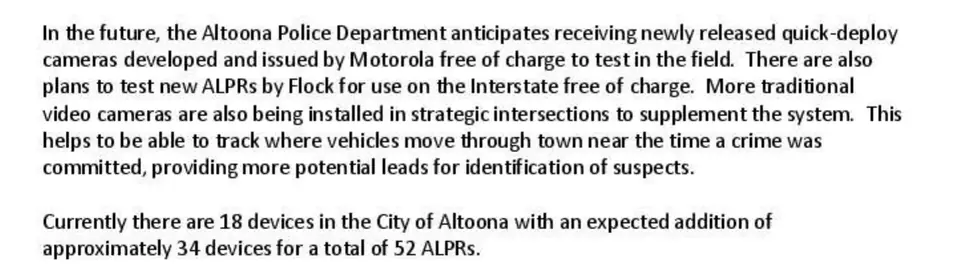
From 18 cameras to 52, in the department’s words
 Open the full page (PDF)
The 2024 white paper’s plan for the network, as printed. Council approvals and the vendor’s own camera counts are on the ALPR tracker.
Source: Police ALPR white paper, February 12, 2024, page 6, released under Iowa Code chapter 22; redacted copy (about this record).
Each order step by step
Loading the camera-counts feed…
Sources in both directions
Where the site cites these records
Each page below states a fact one of these records supports and links back here.
Pages that cite these records
| Page | Records it cites |
|---|
Source: records-requests.json, each record’s cited_by list.
Iowa Code chapter 22
Ask for records yourself
Iowa’s open-records law starts from public access to government records, and it works best when a request is specific and tied to records that already exist. These are the baseline rules and the City of Altoona steps that matter most to a local requester. Check the official sources before relying on any legal or procedural detail.
Chapter 22 is about existing public records.
Official records start from disclosure. Chapter 22 sets a general policy of public access to government records. It covers records the government already has; it does not require an agency to answer open-ended questions, conduct research, or create a new report just because someone asks.
Some records or details can still be withheld. Agencies can withhold records or redact parts of them when another law makes the material confidential, so a response can be a full release, a partial release, or a denial tied to a cited exemption.
You can request records in more than one way. IPIB’s Chapter 22 FAQ says Iowa Code section 22.4 allows requests in person, in writing, by telephone, or by electronic means. A custodian can ask clarifying questions, but the law does not let the agency force you to explain your purpose for asking.
Describe records, dates, and formats. Identify the record type, relevant department, date range, project name, and whether you want inspection, electronic files, or paper copies.
Iowa does not set a hard response deadline, but delay still matters.
No fixed number of days in Chapter 22. IPIB’s FAQ says Chapter 22 does not impose a specific response deadline. Instead, the question is whether the delay is reasonable. Prompt acknowledgment, status updates, and rolling production all help show that an agency is responding rather than silently refusing.
Some records should move faster. IPIB says minutes and materials considered in open session should generally be produced within a few business days because those records are not confidential in the same way other files can be.
Fees should track actual, direct costs. IPIB says copy and supervisory fees must be based on actual, direct costs. That can include printing or staff time used to make and provide copies, but not indirect overhead like electricity or insurance.
Attorney time is limited to confidentiality review and redaction. IPIB’s FAQ says legal services may be billed only for reviewing or redacting confidential information, not for the initial search for responsive records.
Practical takeaway: ask for a written estimate if fees may be significant, and ask the city to produce clearly releasable records first if review or redaction will slow the full response.
City of Altoona request path
Use the city request form or call the City Clerk’s office. Altoona’s public-records page points city requesters to the Public Records Request form and lists the City Clerk’s office for follow-up at (515) 967-5136. City Hall is at 900 Venbury Dr., Ste A, Altoona, IA 50009.
Include enough detail to identify the record.
- Name the department or subject, such as Council minutes, permits, invoices, emails, or contracts.
- Give a date range, project name, vendor name, or agenda item if you have one.
- Say whether you want inspection only, electronic copies, or paper copies.
- Provide a way to reach you for clarifying questions and fee estimates.
The city may clarify scope, estimate fees, or release records in stages. Broad requests may take longer, especially when staff must review records for confidential material. If the city expects a delay, ask for an acknowledgment, an estimated production date, and rolling releases of records that are already ready to disclose.
Ask for the records, not an explanation. A Chapter 22 request is strongest when it targets existing documents. Instead of asking the city to explain what happened, ask for the emails, minutes, invoices, contracts, permits, or reports that document what happened.
Ask for the cited exemption, then decide whether to challenge it.
Redactions are often more appropriate than blanket refusal. If only part of a record is confidential, ask for the nonconfidential remainder with redactions marked. Also ask the city to identify which Chapter 22 exception or other law it is relying on.
Iowa Public Information Board complaints are an administrative option. IPIB accepts formal complaints through its File a Complaint page. Its FAQ also points to district court as another avenue for challenging an unlawful denial or unreasonable delay.
Before escalating: keep a dated copy of your request, any acknowledgment, fee estimate, and the exact denial language. That paper trail matters if you later ask IPIB or a court to review the response.
Primary sources for this guide
- Iowa Code Chapter 22 (official legislature PDF): the controlling statutory text for Iowa’s examination of public records law.
- IPIB Chapter 22 frequently asked questions: official state guidance on request methods, response timing, fees, delays, and other common records questions.
- City of Altoona public-records page: the city’s public-records overview, request links, and City Clerk office phone for follow-up.
- The sourcebook: every other public record and data source this site uses.
Method
How we redact
Spot something we missed, or a fact on this page that is wrong? Tell us and we will fix it and say so on What’s new.