Why this site exists
Analysis / opinion. This page is the site’s position, not a record. Every factual statement on it links to the record or source it comes from; where a point rests on our own experience or belief, it says so. The rest of the site shows the records as they are, and About this project explains how.
Our position
Mission
If they watch us, we watch them, using only public, legal data.
Deflock Altoona documents how license plate readers came to Altoona, how they spread, and how the city has explained them.
Whether the cameras work isn’t our argument. Our argument is about whether a town should put its residents under constant watch just because it can. That’s a moral and ethical question. The courts haven’t finished answering it, and the Council never really asked it.
On the record: the City’s program page says the cameras moved into the police budget after the 2022 pilot “produced measurable investigative results” (police page), and Flock’s portal for Altoona says the department uses retroactive search “to solve crimes after they’ve occurred.” We take them at their word.
We don’t want to be watchers. We built this site because the city left us no other way to see what it’s doing, and in doing so we built a small version of the thing we object to. That’s the point. If collecting public records about officials feels uncomfortable, picture it pointed at every car in town. The difference is where we drew the line: we watch institutions and public acts, never private people, and we publish our methods (with every source and its limits on About and the Sourcebook).
We hold ourselves to the same standard we ask of the city: public sources, cited claims, and corrections when the data proves us wrong. It already has, and What’s new dates every fix.
Why we believe this
Each card below is the site’s position, followed by the records behind it. Open one, or use the header’s Detail: Full to open them all.
The word games don’t hold up
Our position
“One camera doesn’t track you.” “A snapshot isn’t tracking.” “This isn’t facial recognition.” Each statement is technically true on its own, and each one skips the next logical step.
A single read is a snapshot: one car, one place, one moment. But a car that passes the same cameras every day, on the way to work, to school, to the store and home again, is read over and over. As an example, a driver whose daily routine passes a few cameras could be read thirty times a day; kept for a month, that is hundreds of reads, and put in order they show when that person leaves home, which way they go and when they come back. That is a movement history, and nobody had to follow anyone to build it. What upsets us is that each official description stops one step short of saying so.
The Supreme Court has already recognized this about other technologies. In United States v. Jones (2012), it held that attaching a GPS tracker to a car and following it for four weeks was a search under the Fourth Amendment. In Carpenter v. United States (2018), it held that police generally need a warrant to get a phone company’s historical records of where a phone has been, because a long record of someone’s movements reveals the private details of their life. Neither case was about plate readers, and courts have not settled how those rulings apply to them. On October 1, 2026, a federal district court in Oklahoma held that a deputy’s search of plate-reader systems, Flock among them, for a driver’s month of past locations “was a search under the Fourth Amendment” that “was not supported by probable cause, and it was done without a warrant” (Case No. 4:26-cr-00189-SEH, N.D. Okla., Opinion and Order, p. 37). It decides only its own case, and it is not binding in Iowa, which is in the Eighth Circuit; the same court notes that, by its research, it appears nearly every court to rule on the question so far has found plate-reader use is not a search. Our argument is that plate readers build the same kind of record with no warrant at all.
On the record
- The City’s program page says a plate reader records a plate, the vehicle, a time and a camera location; that it “is not facial recognition”; and that it does not continuously follow a vehicle between cameras (police page, card “A vehicle observation, not a tracking device”).
- Flock’s portal for Altoona lists what it does not detect as “Facial recognition, People, Gender, Race.”
- On warrants, the City’s page says every search needs a documented law-enforcement reason and case number (police page), and Flock’s portal says “All system access requires a valid reason.” Neither mentions a warrant or a judge.
What a search of past plate reads returns
A court exhibit from outside Iowa: bodycam frames of a deputy’s plate-reader query on a patrol-car screen, a list of dated sightings beside a map of where cameras saw the car. The federal court in Oklahoma reproduced them in its October 1, 2026 Opinion and Order (pp. 4 and 17), which held that search unconstitutional; that ruling is not binding in Iowa. The frames are blurry in the filing too.
The exhibit and its source Bodycam frames from the filingOpen
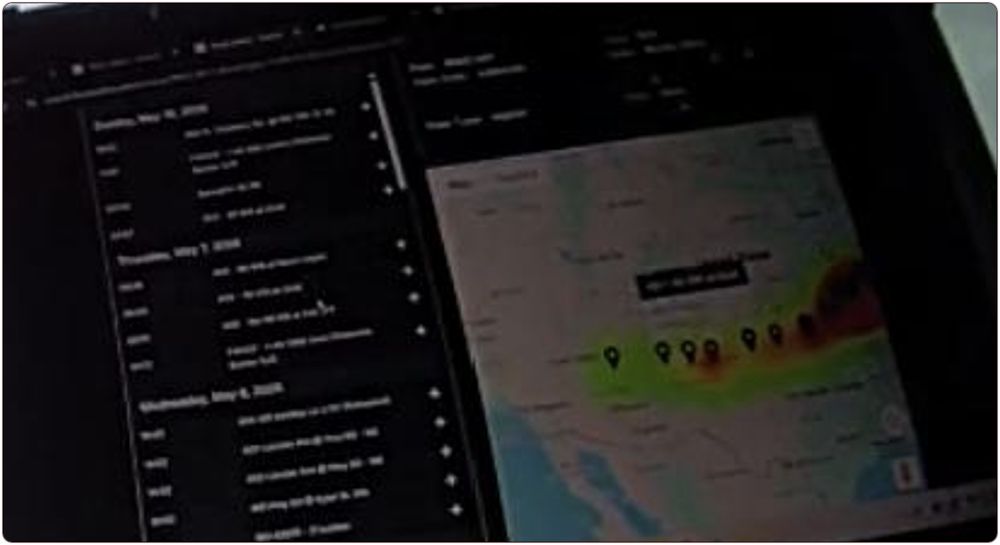
Source: U.S. District Court, N.D. Okla., Case No. 4:26-cr-00189-SEH, ECF No. 62, Opinion and Order, pp. 4 and 17 (bodycam exhibit, ECF No. 47-6). The ruling, beside the City’s legal reasoning.
How many reads, from the vendors’ own portals
Takeaway: every day adds more reads, and each is kept for 30 days.
Table, notes and source Vendor counts, with our averagesOpen
| Figure | Count | As of |
|---|---|---|
| Loading the vendors’ figures. They are also on the ALPR tracker. | ||
The per-day and per-camera rows are our arithmetic on Flock’s 30-day total, averaged; they are not figures Flock publishes. Reads are events, not different vehicles: one car passing twice counts twice. A hotlist hit is an alert, not a confirmed stop or arrest.
Source: the Flock Safety and Axon transparency portals for the Altoona Police Department, as collected on the ALPR tracker. See it over time: Flock’s figures over time.
Our notes beside the City’s own statements: “A vehicle observation, not a tracking device” and “30-day deletion” on the police page.
The watcher doesn’t need to be watching
Our position
In 1791 Jeremy Bentham designed the panopticon: a prison where one guard could see every cell, but no prisoner could tell when he was being watched. The guard barely matters. The possibility of being watched is enough to make people police themselves. Michel Foucault argued in Discipline and Punish that this is how modern power works: through visibility that people eventually carry around inside them.
Writers saw where that leads: Yevgeny Zamyatin’s We imagined citizens in glass apartments, and Orwell, who read it, built Nineteen Eighty-Four around a telescreen that works because no one knows when it’s actually watching.
Around here people still leave their bikes unlocked, yet these cameras make residents feel locked up. That isn’t a paradox. It’s how the design is supposed to work. A camera on your street doesn’t need anyone behind it to change how it feels to walk out your front door.
On the record
- The department’s 2025 annual publication, linked from the police page, describes the Altoona Real-Time Intelligence Center (ARTIC), which it says joins city cameras, plate readers, drones, dash cameras and body cameras that used to be separate systems. It says a call for service can automatically activate nearby cameras and sensors before officers arrive.
- The July 5, 2022 minutes record the Finance Officer/City Clerk explaining that “The police department is requesting to create an intelligence analyst position.”
We read the department’s own description as our concern, stated in its words. Cameras, plate readers, drones and body cameras joined into one center, switching on by themselves when a call comes in, is exactly the watcher Bentham described: a single point that can see everywhere at once. The department presents it as a first for Iowa. We think a first like that should have been debated in a Council meeting before it was built, not shown off afterward.
Our note beside the department’s own description: “ARTIC: a unified real-time crime center” on the police page.
Transparency on paper isn’t transparency in practice
Our position
Years of decisions have left a thin public record. Key facts sit in plain sight: in consent agendas, in unanimous votes without discussion, or in invitations to “come see the command center” instead of clear statements in the minutes where residents look. A consent agenda is a list of routine items the Council passes together in one vote, without discussing each one. Nothing was hidden in the legal sense. Almost nothing was said out loud, and that is what upsets us.
Kafka saw this too. In The Trial, the system controlling Josef K.’s life is never hidden; it sits in plain sight in back offices, behind so much process that no one can find out what it’s doing. Here, the department promotes its real-time crime center with invitations to come see the command center, while the Council minutes on this site don’t name it at all.
Rolling 30-day data windows, anti-scraping measures on transparency portals, and the cost of gathering it all keep this information out of reach of ordinary residents. Both vendor portals show only the last 30 days, so a day nobody saves is gone for good. Our data will have gaps. The gaps are part of the finding.
On the record
Every camera item we found in the Council minutes since January 6, 2020
Takeaway: three items, all passed inside consent agendas, none with a no vote.
Table, notes and source Three items, with dates and votesOpen
| Meeting | Item as printed | How it passed |
|---|---|---|
| May 2, 2022 | Consent item 11(q): “Consider adding cameras from Baker Group contract to City Fiber Project ($157,956.00)” | One roll call on a 24-item consent agenda: 5 aye, 0 no |
| November 18, 2024 | Consent item 11(e): “Consider approving Baker Group Proposal for Phase Two Traffic Cameras.” | One roll call on a 17-item consent agenda: 4 aye, 0 no, 1 absent |
| July 21, 2025 | Consent item 12(c): “Consider approving Axon Enterprise, Inc., Master Services and Purchasing Agreement.” | One roll call on a 15-item consent agenda: 4 aye, 0 no, 1 absent |
The first two are City traffic cameras, not plate readers; we list them because the department says city cameras feed ARTIC. Only the Axon item is a plate-reader contract, and the minutes give no dollar amount for it. We searched the minutes published on this site for cameras, Flock, Axon and license-plate readers (known limits).
Source: City Council minutes, as recorded on /votes.
The City’s own approval timeline, checked against the minutes
Takeaway: of the four stages the City lists, only one matches a Council record.
Table, notes and source The four stages, one matchedOpen
| Stage the City lists | What the Council record shows |
|---|---|
| Loading. The same check is on the police page. | |
Source: the City of Altoona’s ALPR technology page (its approval FAQ) and the Council minutes on /votes.
- The Council’s roll calls since 2020, and how few drew a no vote or abstention, are counted on the Council page.
- In the department’s own words, ARTIC “was born, making it the first real‑time crime center in the state of Iowa,” and “[t]he evolution of public safety technology in Altoona is only beginning” (2025 annual report, outside link; our notes beside each quote are on the police page). We have not found ARTIC named in the Council minutes on this site. In our experience it has been promoted with invitations to come see the command center, not stated in a Council meeting.
- The first public comment about the cameras we can find in the minutes came on September 8, 2026, and public comment topics since 2020 show how rare the subject has been.
Our notes beside the City’s own statements: the Council approval timeline and ARTIC cards on the police page.
Legal isn’t the same as right
Our position
The program could be justified under the legal reasoning the city cites. That doesn’t make it wise. A town that logs every passing car has decided, before anyone has done anything, that visitors and neighbors coming home are worth watching.
Expanding into residential neighborhoods without notice to the people who live there is the escalation we object to most. Finding a camera on your street, with no letter, no meeting and no explanation, turns this from a policy question into a personal one.
Altoona moved ahead of state and national lawmakers who are still setting the limits, and ahead of courts that are still weighing in. We don’t want our town to be the test case.
On the record
- The City’s program page cites a federal appeals ruling, United States v. Porter (Fifth Circuit, 2026), which held that the plate-reader use in that case was not a Fourth Amendment search, and an Iowa law it describes as requiring plate data to be deleted within 30 days unless copied into a case file. The same page says courts still weigh each system’s reach, retention and use case by case (police page).
- The City’s page dates a 10-camera Flock pilot to 2022 and an expansion to 2024 (the department’s own 2024 order form, from a records request, is for 29 cameras), and says the Axon agreement approved July 21, 2025 included Axon’s Outpost plate-reader units.
- At the September 8, 2026 meeting, a resident asked the Council about Axon camera installations at three neighborhood locations. We have not found any notice to neighbors in the Council record.
Outside reporting
- External report 404 Media, October 2, 2026 (Jason Koebler): “Federal Judge Rules a Flock Search Was ‘Indiscriminate Mass Surveillance’ and Unconstitutional”. Reports a federal district court ruling in Oklahoma that a deputy’s warrantless plate-reader search for a driver’s past locations was a Fourth Amendment search, one of two grounds on which the court suppressed the evidence (Case No. 4:26-cr-00189-SEH, ECF No. 62; the court’s Opinion and Order). Not binding in Iowa: the court is in the Tenth Circuit, Iowa in the Eighth, and 404 Media reports Flock said it expects the ruling “will be appealed and ultimately overturned.” The card on the police page sits beside the Fifth Circuit ruling the City cites.
Our note beside the City’s legal reasoning: “A cited Fifth Circuit ruling” on the police page.
A local fight shaped by national forces
Our position
License plate data doesn’t stay local. Once it enters shared networks, what happens to it depends on policies set far from Altoona, by agencies and politics our City Council doesn’t control. A small-town camera becomes part of someone else’s system. Shoshana Zuboff’s The Age of Surveillance Capitalism describes the economics underneath: data about people’s movements is valuable, and the companies collecting it are paid to collect more. The questions that matter are structural: where the data goes, who can query it, and which policies govern it. A department that flags cars driving into town from lists compiled somewhere else is, in our view, closer to a special-operations unit than to a police department that is part of this community.
On the record
- Flock’s portal for Altoona names its hotlist sources as NCIC (the FBI’s national crime database) and NCMEC Amber Alerts. Axon reports hotlist hits by category (see the tracker).
- The same portal lists as prohibited uses “any searches from outside agencies related to immigration enforcement or reproductive care investigations,” which shows that outside agencies’ searches are governed by the vendor’s policy, not by anything the Council voted on.
- The portal’s list of agencies Altoona shares data with is not shown publicly; Eyes On Flock’s copy of the portal records it as “Redacted” (where the tracker gets its figures).
Outside reporting
- External report 404 Media, August 4, 2026: “‘DO NOT MENTION ALPR USAGE’: How Cops Are Trying to Hide Their Use of Flock”. Reports on a Wapello County, Iowa policy telling officers not to mention the cameras to people they stop or in their reports.
- External report Electronic Frontier Foundation, August 13, 2026: “Too Little, Too Late: Flock Admits Their Technology Needs Reforms”. An advocacy group’s analysis of Flock’s new data-sharing limits, arguing police should need a warrant to search past plate data.
- External report Electronic Frontier Foundation, September 14, 2026: “The High Crime of ‘LMAO’: How Cops Are Treating Flock’s Mass Surveillance As a Joke”. An advocacy group’s review of reasons officers elsewhere entered for Flock searches, and the lack of warrant requirements.
More coverage, labeled separately from Altoona records, is on the News page. More outside reports, each a link to the outlet's own page:
Our note beside the department’s stated mission: “Department page” on the police page.
Why we lead with the cameras residents have mapped
Our position
The department does not publish where its cameras are or how many it runs, and each vendor’s portal counts only that company’s own plate readers. So the clearest picture most residents have is the one volunteers built, spotting cameras and adding them to a public map. That map may be incomplete or wrong in places, and we label it unverified.
We lead with it anyway, because it is the picture people actually live with: what neighbors see on their drive to work shapes how watched this town feels, whatever an official count would say. If the City thinks the number is wrong, the fix is simple: publish the real inventory.
Until then, the tracker’s camera count shows the residents’ total first, labeled unverified, with a switch to show only the vendor figures from the companies’ own portals.
What it costs us
Our position
Altoona markets itself as a destination. We worry it’s becoming known as the surveillance capital of Iowa instead. That is a worry, not a finding, and we don’t publish tourism figures to argue it. We’ll track property values near mapped cameras, along with public crime and safety statistics, using only approved public aggregates, and let the numbers show whether that concern holds up.
On the record
Flock cameras reported by nearby police departments, archived snapshot
How Altoona’s reported Flock camera count compares with nearby departments.
Table, notes and source Nearby departments, archivedOpen
| Police department | Flock cameras | Archived |
|---|---|---|
| Loading the archived snapshot. The comparison is also on the tracker. | ||
Each department’s own count on Flock’s portal, from Internet Archive captures of Eyes On Flock’s copy; an archived snapshot, not a direct collection. Flock cameras only: Axon does not publish a camera count. Camera counts say nothing about crime or safety.
Source: Flock Safety transparency portals via archived Eyes On Flock captures, on the ALPR tracker.
- Camera growth: the City’s page dates a 10-camera pilot to 2022 (police page); Flock’s portal count since then is charted on the tracker.
- Property values, method first: what we measure is the median arm’s-length residential sale price and the number of sales, from public county assessor sales records. The comparison areas are Altoona against the other Des Moines metro cities with archived public sales exports (already on the Local page), and later, within Altoona, fixed distance bands from reported camera locations. The time window runs from the earliest year the archived exports cover through the last complete year, with the current year labeled partial. Any group with fewer than 20 sales is hidden. The camera map behind the bands is volunteer-built and unverified, install dates are unknown, and no result will be presented as the cameras’ effect. We will report the findings whichever way they point.
- Crime and community statistics: the FBI’s reported-offense series and the Census Bureau’s American Community Survey estimates on the Local page. They describe the city as a whole and never say whether the cameras work.
What we’re asking
Our position
First, we hold ourselves accountable. Residents, including us, didn’t pay attention when the information was hard to find. That stops now.
Show up to Council meetings. Comments made there enter the minutes, and the minutes are the permanent record that voters, reporters and future councils use to judge what this Council knew and did. This site exists to read that record, so every comment made in public becomes part of what we can show.
Based on the city’s own statements, we don’t expect the current leadership to change direction soon. That makes the record more important, not less: it is what voters will have when the seats come up. Vote, and elect leadership that will answer to it.
Public records are the power residents still hold. We intend to use all of it, and we’re asking you to use yours. The levers are plain: speak at Council meetings, file public-records requests, contact your state legislators about plate-reader rules (find your districts), and vote.
What we ask of the Council and the department: put every camera contract, renewal and expansion on the agenda as its own item, not inside a consent agenda; announce new capabilities like ARTIC in a Council meeting, where they go into the minutes; tell neighbors before a camera goes up near their homes; publish the dates and records for every stage of the program; and require a warrant to search past plate data.
On the record
- The September 8, 2026 minutes, answering residents’ comments on the cameras: “Mayor O’Connor stated he is a big supporter of the LPR’s. He stated there will be continued discussions in the future and the council will make the decisions about them.”
- The November 6, 2023 minutes: “Mayor O’Connor stated the City of Altoona received the Technology Community of the Year Award from the TAI organization.”
- The department’s 2025 annual publication presents ARTIC as the first real-time crime center in Iowa (police page).
- The same report says “every search or query is logged and auditable. All ALPR systems are audited quarterly” (2025 annual report, outside link; our notes beside each quote are on the police page). Those audits are records residents can ask for.
- Whether the public makes itself heard will show in the record: public turnout at each meeting and public comment topics. The Local corner shows the next meeting and explains how to speak.
- The Council roster shows when each member’s current term ends. This site does not endorse or oppose any candidate.
Our reading of those statements is an inference, and we would be glad to be proven wrong at the next meeting.
Our position
Who runs this site
This site is run by an Altoona resident who pays attention to how the City works. What drives the site is finding the gap between what a system is said to do and what it can actually do, and how systems produce outcomes the people inside them can’t see or feel powerless to change.